Workshops
Tanzen3000 offers two tracks of events. We’ll first give you a brief description for orientation. If you like to know more, scroll down to where we add a deeper commentary on these two approaches.
Classic Session
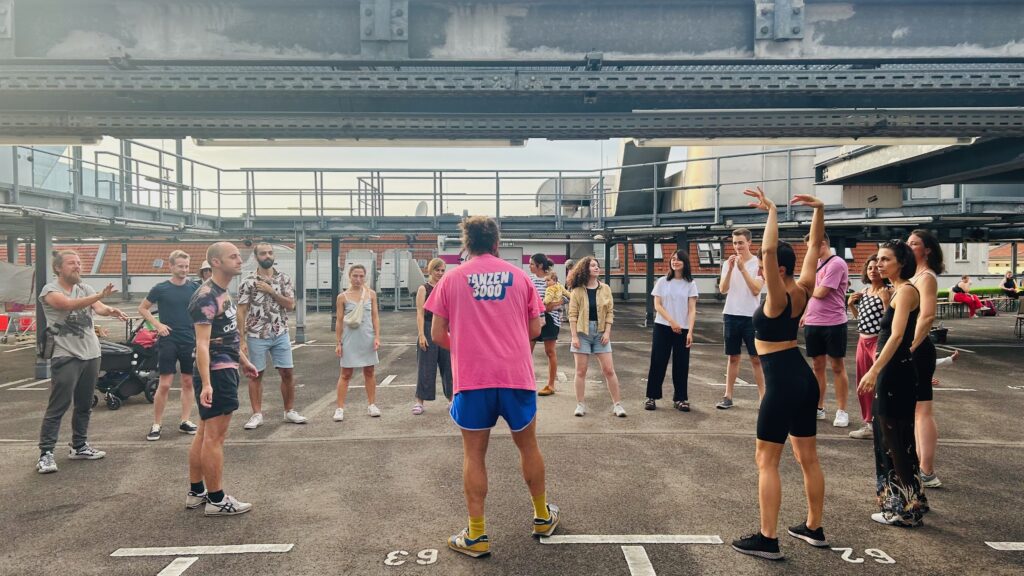
This format is the root of Tanzen3000, and it’s for you if you just want to dance however the f*ck you like, you value playful attitude over rigid technique, and you appreciate diverse music. Our workshops here are open to all levels and particularly beginner-friendly. We share basic movement concepts that you can instantly play with on the dancefloor, to any style of music. We call these “spices”. You can chuck them into your own soup and see what helps you to find a flavour.
The Better Move
We started this new format in 2025, out of an urge to acknowledge that, while movement is free and accessible to all, specific dance and music cultures exist, many rooted in queer and BIPoC communities, that are foundational to club culture.
The Better Move session invites guest dancers and djs who puts a spotlight on specific club dance styles, and we add culture talks to the programme. The event combines our core aim – creating a dancefloor for dancing, accessible to all levels of experience – with a deeper dive into the culture and context.

Many people who like dancing see it as a universal language. The beauty of it lies in moving however you want, to whatever sound you like, and being surrounded by others — each moving differently, yet all involved in the same moment. Dance, in this view, is just expressing what you feel. Open to everyone, everywhere, at any moment.
This perspective has created meaningful spaces where people can come together, move without judgment, and celebrate differences.
As always, there’s another truth.
Much of club culture was shaped by musicians and dancers who weren’t seeking universality, but to create something that set them apart. Distinct genres and styles emerged — each carrying distinct flavours informed by specific local contexts.
Funk, House, Techno, Hip Hop, Amapiano, Baile Funk, and others originated from groups of BIPoC artists living through struggle and exclusion – quite the opposite of ‘anyone can do whatever they like at all times’.
This freedom that a dancefloor can offer hits differently when you dive deeper into the histories of liberation resounding in club music and club dance cultures.
Thus, the understanding of music as universal frequency and dance as spontaneous self-expression is merely one of two truths.A dance-forward space will hold both perspectives: encouraging us to wiggle the way we want to — and raising awareness for cultural legacies that can help us connect even more deeply.